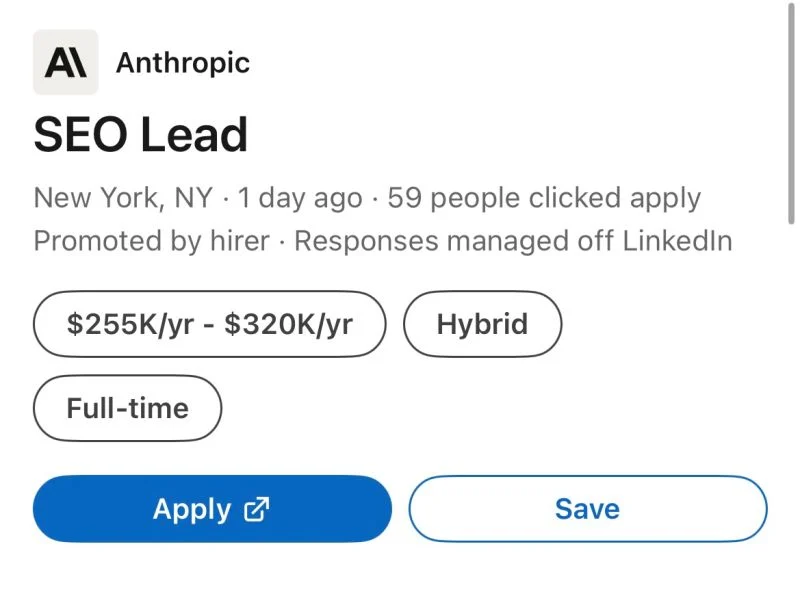
There’s a contradiction happening right now that should make you pay attention. Anthropic has an open SEO Lead position. Meta is actively recruiting for SEO Strategy Lead roles across multiple locations. OpenAI posted a Growth – SEO, CRO and Web Strategy position just months ago.
These are expensive hires. These are strategy-level positions. And these are companies that literally built the AI tools that the rest of the world thinks will replace marketing teams. Meanwhile, in a different corner of the business world, companies are making very different decisions. They’re cutting content budgets. Laying off writers. Shutting down SEO teams. The logic is straightforward: if ChatGPT and Claude can generate blog posts, why pay people to write them?
One of these two groups is about to learn something expensive. And if you work in marketing, you need to know which one has it right.
The Tool Makers Aren’t Using Their Own Tools as a Shortcut
Let’s be clear about what these job postings actually mean.
Anthropic, Meta, and OpenAI didn’t hire expensive SEO and strategy leaders because SEO suddenly became more important. They hired them because they discovered something that everyone else is still in denial about: having access to the tool and knowing how to use it strategically are completely different problems. If the people building Claude and ChatGPT thought “just generate content with AI” was a viable strategy, they wouldn’t need these roles. They’d be running their content operations with the same models they’re selling to everyone else. Instead, they’re doing the opposite. They’re paying for human strategists who understand how to think about content in the context of their business, their audience, and their competitive position.
That’s not them being hypocritical. That’s them showing their work. When you have a tool that makes execution cheap, what becomes expensive is the decision-making layer. Strategy. Direction. Understanding which of infinite possible pieces of content actually matters for your business. That’s what you pay for now.

What Companies Are Actually Doing When They “Cut Marketing Budgets”
Here’s what happens when a company decides to replace their marketing team with AI tools:
They generate a lot of content. Lots and lots of it. Blog posts about every conceivable topic. SEO checklists. AI-generated case studies. Comparison guides. Content calendars filled for months. Then nothing happens. The content doesn’t rank. Or it ranks poorly. Or it ranks fine but nobody reads it because it says the same thing as fifty other pieces that were generated with the same prompt, by the same tools, with the same logic.
The reason is simple: they outsourced execution without thinking about strategy. They cut the people who were deciding what to write about, and kept the tool that could write anything. That’s like firing your product manager and keeping your code repository. The tool is useful, but it’s not the thing that mattered.
The timeline is deceptive right now. In month one, cutting your marketing budget feels like a win. You’re saving money. Content is still getting published. Nothing feels broken yet.
By month six or twelve, the gap becomes visible. Your competitors the ones who kept their strategists and added AI tools to their workflow are ranking for keywords that matter. They’ve built topical authority. They have a narrative. Their content gets read because someone decided it was worth writing. Your company has 200 pieces of content that say nothing in particular to nobody specific.
The Real Problem Isn’t AI. It’s Confusing Execution with Strategy
This is where most companies get it wrong. They see that AI tools can handle execution (writing, editing, formatting, publishing) and assume that execution was the valuable part. It wasn’t. Execution was the expensive part, the valuable part was always the strategy. In a normal marketing team that’s someone deciding:
- Which keywords matter for our business, not just which ones are easy to rank for
- What our customer actually needs to know, not what an AI can generate
- How these pieces of content connect to build authority over time, not just exist as isolated posts
- When to use the tool and when to do something different
- What our actual point of view is, and why it matters
That person is more expensive than the writer they replaced. Not less. And if you laid them off to save money on content generation, you’ve just discovered that the money you saved was irrelevant compared to the strategy you lost. The companies hiring expensive SEO and strategy leaders already know this. They’re not trying to cut costs, they’re trying to win.
Why This Matters If You Work in Marketing
If you’re worried about your job right now, here’s what you actually need to understand:
The AI tools are real. They’re getting better. Companies are going to use them. But the companies that use them effectively are the ones that treat them as a multiplication layer on top of existing strategy, not as a replacement for the thinking. That means the jobs that are getting cut aren’t the strategic ones. They’re the execution-only ones. If your job is “write blog posts,” you’re in trouble. If your job is “decide what blog posts matter and why,” you’re not. This isn’t comforting if you’re in the first category. But it’s useful to know early, because the companies that are figuring this out right now are the ones that will still need strategists in two years. The companies that are betting everything on tools will be figuring out why their content strategy didn’t work.
The question for you is which group you want to be in. And more importantly, which job are you actually doing right now?

The Companies Showing Their Work
What Anthropic, Meta, and OpenAI are doing is signaling something clear: strategy matters. The tool is useful, but it’s not the strategy. And if you’re going to win with content, you need people who can think about it strategically. They’re not using their own tools as a cost-cutting measure. They’re using them as force multipliers for people who already know what they’re doing. That’s a different approach than most companies are taking right now. And that’s probably why those three companies will still have working content strategies in 2027, while the companies that fired their marketers to use ChatGPT will be wondering why nothing’s working.
The contradiction isn’t that these companies are hypocritical. The contradiction is that everyone else is missing what they’re trying to tell you through their hiring decisions.
What You Should Actually Be Doing
If you’re a marketer, the move here isn’t to panic about AI. It’s to become the strategic layer that the tool can multiply, that means:
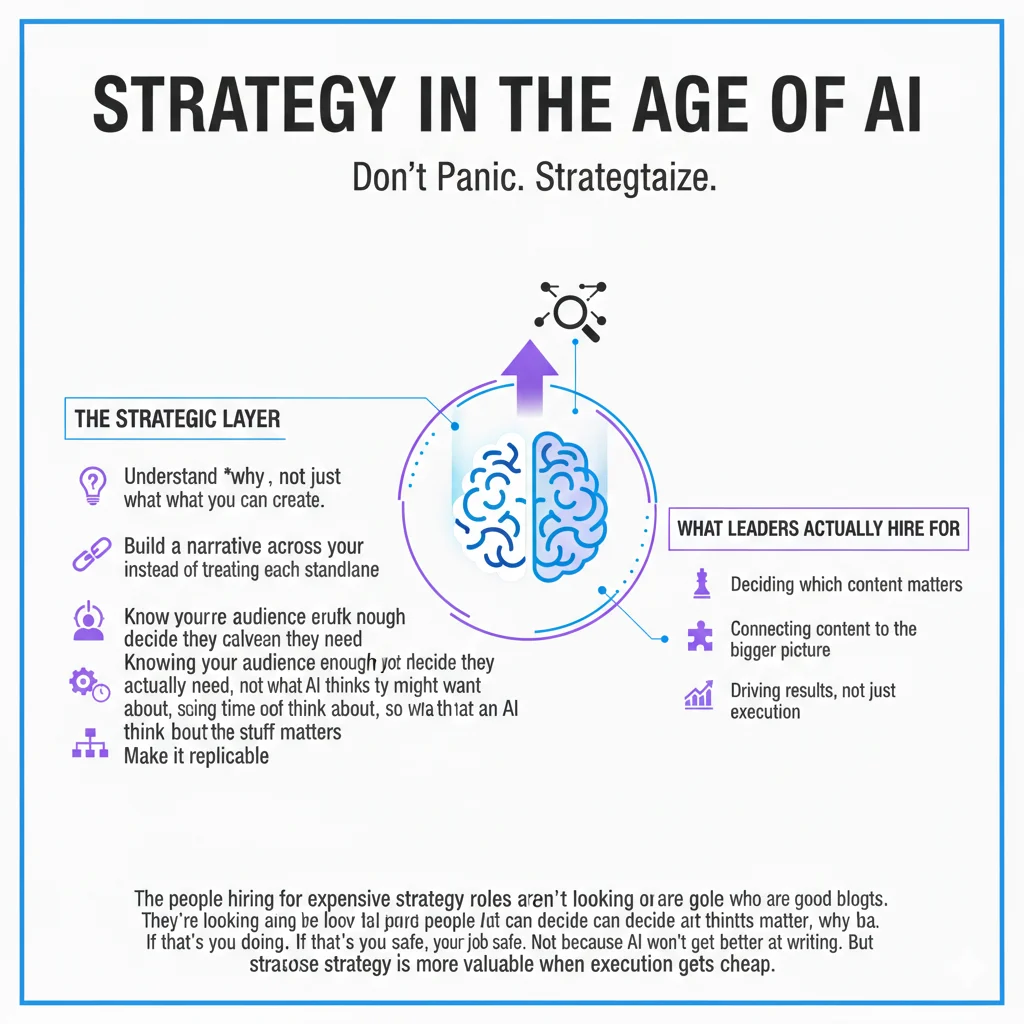
- Understanding why you’re creating content, not just what you can create
- Building a narrative across your work instead of treating each piece as standalone
- Knowing your audience well enough to decide what they actually need, not what an AI thinks they might want
- Using tools to handle the work you don’t need to think about, so you have time to think about the stuff that matters
- Being able to explain your strategy clearly enough that someone could replicate your thinking (which is how you know you actually have one)
The people hiring for expensive strategy roles aren’t looking for people who are good at writing blog posts. They’re looking for people who can decide which blog posts matter, and why, and how they fit into a bigger picture. If that’s what you’re doing, your job is safe. Not because AI won’t get better at writing. But because strategy is what becomes more valuable when execution gets cheap.
The Signal vs. The Noise
Here’s what’s happening right now: there are two different decisions being made by different companies, and they’re not symmetric. One group is saying: “AI can do this work, so we don’t need people.” They’re cutting budgets and laying off teams.
The other group is saying: “AI can handle execution, so we need better strategists.” They’re hiring expensive leaders and giving them tools. Over the next 18 months, you’re going to see which group made the right call. And if you work in marketing, you need to know which side of that decision you’re on. The tool makers already know which side wins. They’re showing you by hiring for it.
The question is: are you paying attention?